



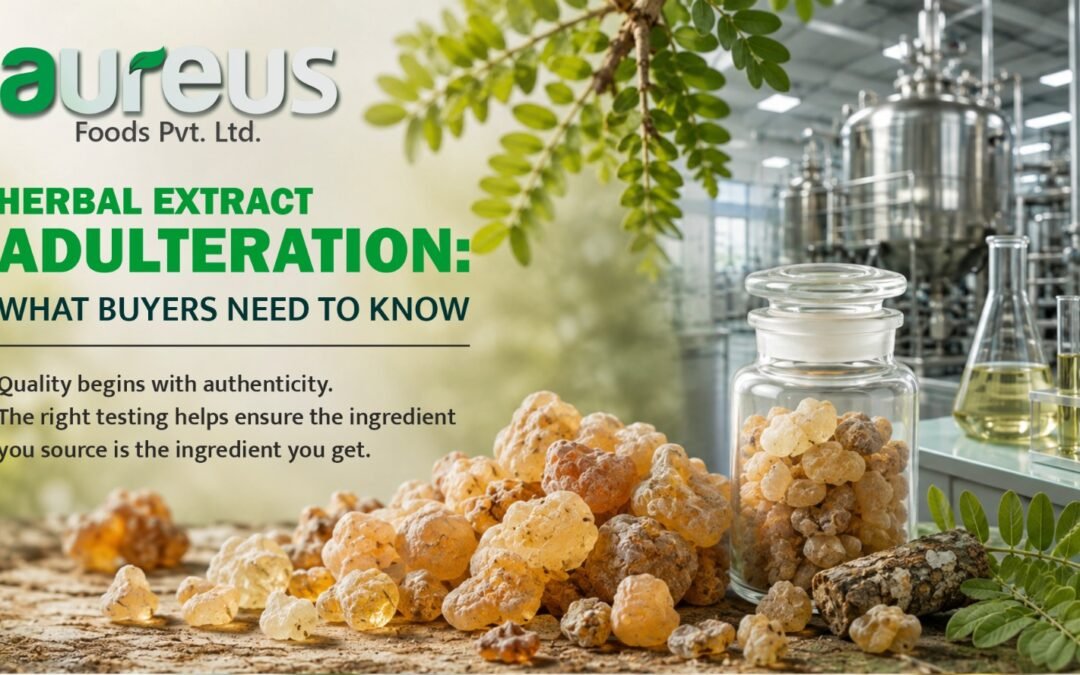
Herbal extract adulteration is an important quality concern for nutraceutical, dietary supplement, wellness, and cosmetic manufacturers. When buyers source botanical ingredients, they need confidence that the material they receive matches the agreed botanical identity, specifications, quality, and potency.
For this reason, herbal extract adulteration screening plays an important role in modern ingredient quality management. Proper raw material verification, quality testing, documentation, and controlled manufacturing can help identify potential quality concerns before an ingredient reaches the finished formulation.
At Aureus Foods Pvt. Ltd., we understand that reliable herbal ingredients begin with strong quality controls. Our approach focuses on controlled manufacturing, quality verification, and testing according to defined product requirements.
What Is Herbal Extract Adulteration?
Herbal extract adulteration occurs when an ingredient does not fully match its declared identity, composition, specification, or quality requirements.
Adulteration can take different forms. For example, an ingredient may contain an undeclared material, a substituted botanical source, lower-quality raw material, or other components that affect the expected composition of the extract.
Therefore, simply identifying an ingredient as “herbal” or “natural” does not guarantee its authenticity or quality.
Buyers need appropriate verification and testing to confirm that the ingredient meets the required specifications.
Why Is Herbal Extract Adulteration a Concern?
Botanical ingredients naturally show variation. Factors such as cultivation conditions, geographical origin, harvesting, processing, and storage can influence their composition.
However, intentional or unintended adulteration can create additional quality concerns.
It may affect:
- Botanical identity
- Purity
- Active marker content
- Potency
- Batch consistency
- Formulation performance
- Product quality
- Supplier confidence
As a result, manufacturers need a structured approach to quality control when sourcing herbal extracts.
Common Types of Herbal Extract Adulteration
Adulteration can occur in different ways depending on the botanical ingredient and supply chain.
1. Botanical Substitution
A different plant species may be supplied instead of the declared botanical source.
2. Addition of Undeclared Materials
An ingredient may contain materials that are not included in the agreed product specification.
3. Dilution
The extract may be diluted or blended with lower-value materials, potentially affecting its expected potency or composition.
4. Incorrect Botanical Identity
Raw materials can sometimes be incorrectly identified due to similarities between related plant species.
5. Quality Variation
Poor raw material handling, processing, or storage can also result in an ingredient that does not meet the expected quality parameters.
The specific risk depends on the botanical material, supply chain, product specification, and intended application.
How Can Buyers Detect Herbal Extract Adulteration?
A single quality check may not be sufficient to evaluate every potential adulteration risk.
Instead, buyers should consider a combination of:
- Raw material verification
- Botanical identity confirmation
- Organoleptic evaluation
- Analytical testing
- Marker-compound testing
- Purity testing
- Microbial testing
- Heavy-metal testing where applicable
- Batch documentation
- Certificate of Analysis (COA) review
The appropriate testing strategy depends on the specific herbal extract and its known quality risks.
Why Botanical Authentication Matters
Botanical authentication is an important part of herbal ingredient quality management.
For example, extracts from different plant species may have similar names or appearances while having different chemical profiles.
Confirming the botanical identity helps manufacturers establish that the raw material corresponds to the declared plant source.
This is particularly important for ingredients such as Coleus, Curcuma, Boswellia, and Berberis, where accurate botanical identification supports consistent ingredient sourcing.
Why Marker Compounds Matter
Many herbal extracts are standardized according to specific marker compounds.
For example:
- Coleus Extract → Forskolin
- Curcuma longa Extract → Curcuminoids / Curcumin
- Boswellia Extract → Boswellic Acids
- Berberis aristata Extract → Berberine
Marker analysis can provide useful information about the composition and consistency of an extract.
However, marker content alone should not be treated as proof of complete botanical authenticity. A broader quality-control approach may be necessary depending on the ingredient and potential adulteration risks.
What Should B2B Buyers Ask Their Herbal Extract Supplier?
Before selecting a supplier, buyers should look beyond the product name and price.
Important questions include:
What is the botanical source?
Ask for clear botanical identification and product specifications.
How is the raw material verified?
Understand how the manufacturer evaluates incoming raw materials.
What quality parameters are tested?
Review the relevant analytical and microbiological testing requirements.
Is the extract standardized?
Check the defined marker compound and specification.
Is batch documentation available?
COAs and supporting quality documentation can help with supplier qualification.
How does the manufacturer handle adulteration risks?
A quality-focused supplier should have an appropriate screening and verification approach based on the product and its known risks.
The Importance of Adulteration Screening
Herbal extract adulteration screening helps manufacturers identify potential concerns and improve confidence in ingredient quality.
However, screening should form part of a broader quality system rather than operate as an isolated activity.
A strong quality approach can include:
Raw Material Verification → Controlled Processing → Quality Testing → Standardization → Documentation → Batch Release
This integrated approach helps manufacturers maintain better control over ingredient quality throughout the production process.
Aureus Foods: A Quality-Focused Approach
At Aureus Foods Pvt. Ltd., we recognize that ingredient quality begins well before the final product reaches the customer.
Our manufacturing approach focuses on controlled processes, quality verification, standardized production, and appropriate testing based on defined product requirements.
We manufacture herbal extracts including:
- Curcumin Extract
- Coleus Extract
- Boswellia Serrata Gum
- Berberine Extract
For each ingredient, quality requirements can vary according to the botanical source, specification, intended application, and customer requirements.
Our focus is to provide customers with consistent, quality-focused herbal ingredients backed by controlled manufacturing practices and appropriate quality verification.
Why Adulteration Awareness Matters
For nutraceutical and wellness brands, adulteration awareness is not only a quality issue. It is also part of responsible ingredient sourcing.
By understanding potential adulteration risks and asking the right questions, buyers can make better supplier decisions and establish stronger quality systems.
Ultimately, trust in a herbal ingredient starts with knowing what is actually in it.
Conclusion
Herbal extract adulteration can affect ingredient identity, purity, potency, consistency, and overall product quality. Therefore, manufacturers and B2B buyers should take a proactive approach to ingredient verification.
Botanical authentication, appropriate adulteration screening, analytical testing, standardization, documentation, and controlled manufacturing can work together to support reliable herbal extract quality.
At Aureus Foods Pvt. Ltd., we believe quality should be built into every stage of herbal extract manufacturing.
Connect With Us
Looking for a quality-focused herbal extract manufacturing partner?
Connect with Aureus Foods Pvt. Ltd. for standardized herbal extract solutions.