



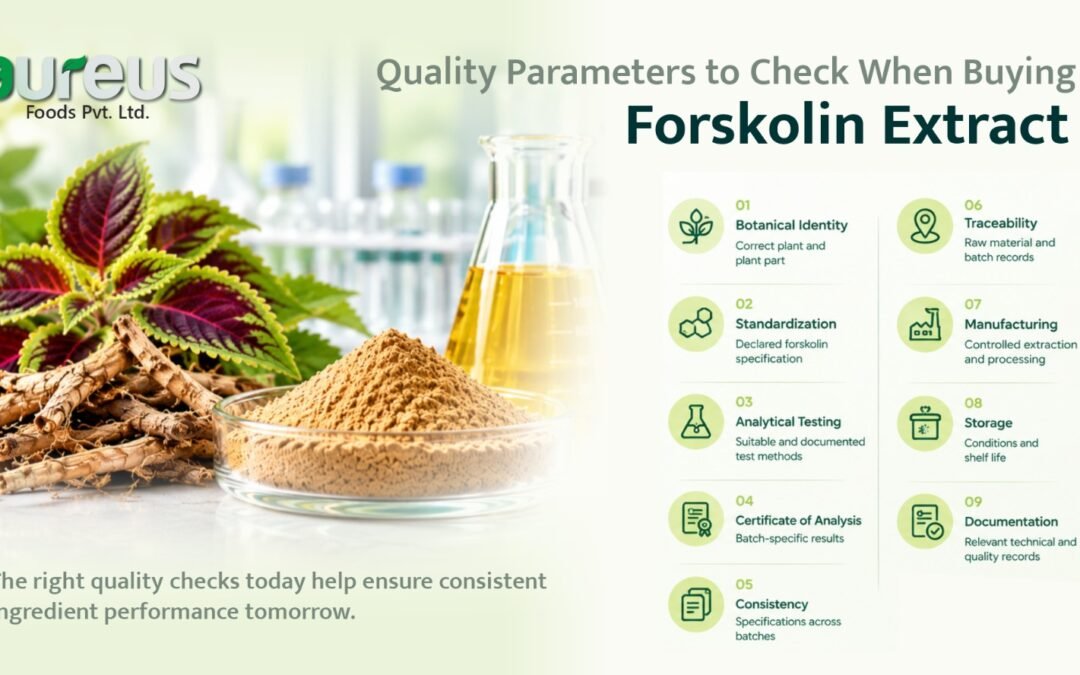
When sourcing botanical ingredients for nutraceutical and wellness formulations, the product name alone does not provide enough information about quality. Forskolin Extract should be evaluated through its botanical identity, standardization, analytical testing, documentation, and manufacturing controls.
For B2B buyers, reviewing these parameters before approving a supplier can help support consistent ingredient quality and reliable formulation development.
What Is Forskolin Extract?
Forskolin Extract is a botanical extract obtained from Coleus forskohlii, particularly from its roots. Forskolin is a naturally occurring compound found in the plant and can serve as a marker for extract standardization.
However, extracts from different suppliers can have different specifications. Therefore, buyers should review the complete technical specification rather than relying only on the ingredient name.
1. Botanical Identity
The first parameter to check is the botanical identity of the ingredient.
The specification should clearly identify:
- Botanical name
- Plant part used
- Raw material information
- Applicable identification requirements
Correct botanical identification helps ensure that the supplied material matches the intended botanical source.
2. Forskolin Standardization
Standardization is an important consideration when evaluating Forskolin Extract.
Buyers should check the declared forskolin content and understand how the supplier defines the specification.
A clearly defined standardization level helps formulation teams compare ingredients and establish consistent requirements across batches.
However, the percentage alone should not determine ingredient quality. Buyers should also review the analytical method used to verify the stated content.
3. Analytical Testing
Analytical testing provides measurable information about an ingredient’s quality and specifications.
Depending on the product requirements, buyers may evaluate:
- Forskolin content
- Botanical identity
- Purity
- Microbial parameters
- Heavy metals, where applicable
- Other relevant quality parameters
The supplier should also be able to provide information about the analytical methods used for relevant specifications.
4. Certificate of Analysis
A Certificate of Analysis (COA) provides important batch-specific information.
Before purchasing, buyers should check whether the COA includes:
- Product name
- Batch or lot number
- Specification limits
- Test results
- Relevant analytical methods
- Testing information
- Release information, where applicable
The COA should correspond to the actual batch being supplied.
5. Batch-to-Batch Consistency
Consistency is important when a botanical ingredient becomes part of a finished formulation.
Natural raw materials can show variation. Therefore, manufacturers need appropriate controls to maintain the required specifications across production batches.
Buyers can review specifications and, where appropriate, compare COAs from multiple batches to understand consistency over time.
6. Raw Material Traceability
Traceability provides greater visibility into the ingredient supply chain and manufacturing process.
A quality-focused supplier should maintain appropriate records for relevant stages of production.
Traceability can support:
- Raw material verification
- Batch identification
- Quality investigations
- Documentation control
- Supply-chain transparency
For B2B buyers, this information can also support supplier qualification and audit processes.
7. Manufacturing Controls
The extraction and processing methods can influence the final ingredient specification.
Therefore, buyers should understand the supplier’s manufacturing controls, including:
- Controlled extraction processes
- Process monitoring
- In-process quality checks
- Batch documentation
- Final product testing
- Storage and handling controls
A defined manufacturing process helps support reproducibility and consistent production.
8. Stability and Storage Information
Proper storage can help maintain ingredient quality throughout its intended shelf life.
Buyers should review available information regarding:
- Recommended storage conditions
- Packaging
- Shelf life
- Retest period, where applicable
- Relevant environmental considerations
This information can help formulation teams plan appropriate storage and inventory practices.
9. Technical and Quality Documentation
Documentation is another important part of supplier evaluation.
Depending on the application and target market, buyers may request:
- Product specifications
- Certificate of Analysis
- Technical data
- Safety information
- Allergen information, where applicable
- Relevant certifications
- Traceability documentation
The exact documentation required can vary according to the intended application and market.
A Practical Quality Checklist
Before approving a Forskolin Extract supplier, buyers can review the following:
| Quality Parameter | What to Check |
|---|---|
| Botanical Identity | Correct plant and plant part |
| Standardization | Declared forskolin specification |
| Analytical Testing | Suitable and documented test methods |
| COA | Batch-specific results |
| Consistency | Specifications across batches |
| Traceability | Raw material and batch records |
| Manufacturing | Controlled extraction and processing |
| Storage | Conditions and shelf life |
| Documentation | Relevant technical and quality records |
Reviewing these parameters together gives buyers a broader understanding of the ingredient and supplier.
Quality-Focused Forskolin Extract Manufacturing
At Aureus Foods Pvt. Ltd., we focus on quality-oriented botanical extract manufacturing with controlled processing and batch-wise quality verification.
Our approach emphasizes:
- Controlled processing
- Quality verification
- Analytical testing
- Batch consistency
- Documentation
- Traceability
These practices support a more transparent and reliable ingredient-sourcing process for formulation companies.
Conclusion
Buying Forskolin Extract involves more than checking the product name or declared percentage.
Botanical identity, standardization, analytical testing, COA, batch consistency, traceability, manufacturing controls, storage information, and documentation all provide valuable information for supplier evaluation.
By reviewing these parameters together, B2B buyers can create a more systematic ingredient qualification process and select specifications that align with their formulation requirements.
Looking for a quality-focused botanical extract manufacturing partner?