



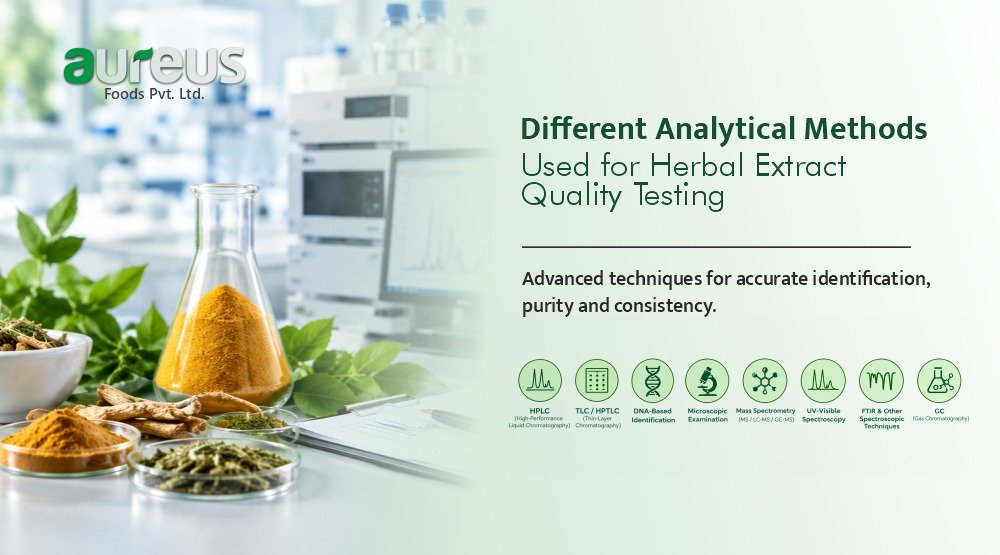
Herbal extracts contain many naturally occurring compounds, so analytical methods for herbal extracts play an important role in checking identity, composition, purity, and consistency. Different tests provide different types of information. Therefore, manufacturers need to choose methods that match the ingredient and its quality requirements.
For B2B ingredient buyers, understanding these methods also helps when reviewing product specifications, laboratory results, and supplier quality documents.
Why Are Analytical Methods Important for Herbal Extracts?
Botanical materials can vary due to growing conditions, plant maturity, harvesting, storage, and processing. As a result, manufacturers need suitable tests to assess these differences.
Analytical testing can help manufacturers:
- Confirm botanical or chemical identity.
- Measure selected marker compounds.
- Check product specifications.
- Compare batch-to-batch consistency.
- Investigate possible adulteration or substitution.
- Assess relevant purity and safety parameters.
However, no single test answers every quality question. The right testing plan depends on the extract, the target compound, and the quality concern.
Different Analytical Methods for Herbal Extract Quality Testing
1. HPLC – High-Performance Liquid Chromatography
High-performance liquid chromatography (HPLC) separates compounds in a sample so analysts can measure selected substances.
Manufacturers often use HPLC to measure marker compounds in standardized extracts. For example, a suitable method may measure curcuminoids in Curcumin Extract or forskolin in Coleus Extract.
The results help the laboratory compare a sample against its defined specification. However, the method must suit the target compound and the sample being tested.
2. HPTLC – High-Performance Thin-Layer Chromatography
High-performance thin-layer chromatography (HPTLC) helps analysts examine the chemical profile of a botanical sample.
It produces a pattern of separated compounds that analysts can compare with a suitable reference. Therefore, HPTLC can support botanical identification and help reveal differences between samples.
Unlike a test that measures only one marker, a chromatographic fingerprint can provide information about several visible components in the sample.
3. TLC – Thin-Layer Chromatography
Thin-layer chromatography (TLC) offers a simpler way to separate and compare compounds.
Laboratories can use TLC for certain identification tests and preliminary quality checks. It can help analysts compare a sample with a reference material under the same testing conditions.
However, TLC does not replace every quantitative test. The laboratory should select a suitable method based on the required result.
4. GC – Gas Chromatography
Gas chromatography (GC) separates compounds that can vaporize under suitable conditions without breaking down.
This method is especially useful for studying volatile compounds in botanical materials. Depending on the ingredient, GC can help assess the composition of volatile constituents and support selected quality checks.
The laboratory must first confirm that GC suits the compounds and sample under investigation.
5. UV-Visible Spectroscopy
UV-Visible spectroscopy measures how a sample absorbs ultraviolet or visible light.
Analysts can use this technique to measure certain compounds when the method provides suitable selectivity and accuracy. It can also support specific identification or quantitative tests.
However, herbal extracts often contain compounds with overlapping absorption patterns. Therefore, analysts must confirm that other constituents will not distort the result.
6. FTIR – Fourier Transform Infrared Spectroscopy
Fourier transform infrared spectroscopy (FTIR) examines how a sample interacts with infrared light.
The resulting spectrum provides information about chemical bonds and functional groups. Analysts can compare that spectrum with suitable references to support identification or sample comparison.
FTIR can be useful for selected screening applications. Nevertheless, it may not identify every compound in a complex extract on its own.
7. Mass Spectrometry
Mass spectrometry (MS) measures the mass-to-charge ratio of ions and provides information about compounds in a sample.
When analysts combine MS with chromatography, such as LC-MS or GC-MS, they can separate complex mixtures and investigate individual compounds in greater detail.
These methods can support compound identification, characterization, and investigations into suspected adulteration. Their suitability depends on the target substances and the analytical requirements.
8. Microscopic Examination
Microscopic examination helps analysts study the physical structures of botanical materials.
For example, characteristic plant tissues and other microscopic features can support the identification of raw botanical materials. This approach is particularly useful before extensive processing changes the plant’s original structure.
However, microscopy has limitations when laboratories examine highly processed extracts that no longer retain recognizable plant structures.
9. DNA-Based Identification
DNA-based methods examine genetic material to help identify botanical sources.
They can support botanical authentication when suitable DNA remains in the sample and the method can distinguish the relevant species.
However, extraction and processing may degrade DNA. Therefore, DNA testing may not work equally well for every finished extract, and laboratories should select the method according to the sample type.
Chromatographic Fingerprinting in Herbal Extract Analysis
Many herbal extracts contain several naturally occurring compounds. Because of this, measuring a single marker may not fully describe the chemical profile.
Chromatographic fingerprinting compares the pattern of separated compounds with a suitable reference profile. This can help analysts assess similarities and differences between samples.
For example, fingerprint comparisons may support raw material evaluation, process monitoring, or batch consistency checks. However, laboratories need appropriate reference data and clear acceptance criteria to interpret the results correctly.
Which Analytical Method Is Best for Herbal Extracts?
The best method depends on the question the laboratory needs to answer.
| Quality objective | Methods that may be suitable |
|---|---|
| Botanical identity | Microscopy, HPTLC, DNA-based methods, or other suitable identification tests |
| Marker-compound measurement | HPLC or another validated quantitative method |
| Chemical fingerprint comparison | HPTLC, HPLC, or other suitable chromatographic methods |
| Volatile-compound analysis | GC or GC-MS |
| Chemical characterization | FTIR, MS, or combined analytical techniques |
| Investigation of suspected adulteration | A targeted combination of suitable methods |
These examples are general guidance rather than fixed rules. The laboratory should select methods according to the botanical material, suspected risk, specification, and intended use of the results.
Why Analytical Method Validation Matters
A test result is useful only when the method can provide reliable information for its intended purpose.
Method validation helps establish whether an analytical procedure performs adequately for the parameter being measured. Depending on the method, relevant characteristics may include accuracy, precision, specificity, linearity, range, and detection capability.
In addition, laboratories should use suitable reference standards, documented procedures, and appropriate controls. These practices help them interpret results and compare samples against defined requirements.
How Analytical Testing Supports Adulteration Screening
Adulteration can involve botanical substitution, incorrect plant parts, undeclared additions, dilution, or inaccurate claims about extract composition.
Different risks require different tests. For example, marker analysis may reveal an unexpected concentration, while fingerprinting or botanical identification methods may help investigate a possible substitution.
However, one test cannot detect every type of adulteration. Laboratories should choose a testing strategy based on the ingredient’s known risks and the suspected adulterant.
For buyers, this means asking suppliers not only whether they test a product, but also which parameters they test and whether the methods address relevant quality concerns.
What Should B2B Buyers Check?
Before sourcing a botanical ingredient, buyers can review the following details:
- Test parameter: What quality characteristic does the test measure?
- Analytical method: Which technique does the laboratory use?
- Specification: What acceptance limits apply?
- Reference standard: Does the method use an appropriate reference?
- Batch results: Are the results linked to the supplied batch?
- Method suitability: Is the procedure appropriate for the ingredient and target?
- Documentation: Are the specification and Certificate of Analysis (COA) available?
- Adulteration risks: Does the testing plan address likely risks for that ingredient?
Together, these checks help buyers assess the quality evidence behind an ingredient rather than relying on its name or appearance alone.
Analytical Quality Control at Aureus Foods
At Aureus Foods Pvt. Ltd., our quality-focused approach to herbal extract manufacturing emphasizes raw material evaluation, controlled processing, analytical verification, batch-wise quality checks, and documentation.
The appropriate analytical method depends on the ingredient, its specification, and the quality parameter under review. This makes method selection an important part of a structured quality-control process.
For B2B buyers, reviewing testing practices alongside specifications and batch documentation can support more informed sourcing decisions.
Conclusion
Different analytical methods provide different insights into herbal extract quality. HPLC and HPTLC can support chemical analysis and fingerprinting, while GC, spectroscopy, mass spectrometry, microscopy, and DNA-based techniques serve other specific purposes.
Ultimately, analytical methods for herbal extracts should match the quality question being asked. Suitable testing, clear specifications, and reliable documentation work together to support ingredient identity, consistency, and quality assessment.
For herbal extract and botanical ingredient requirements, connect with Aureus Foods Pvt. Ltd.
📩 info@aureusfoods.com 🌐 www.aureusfoods.com